Ecosystem Update August 2026
We are excited to bring you the August 2026 Ecosystem Update, covering the latest developments across the macro environment, market performance, the broader industry landscape, and Advanced Blockchain's ecosystem.
Macro Overview
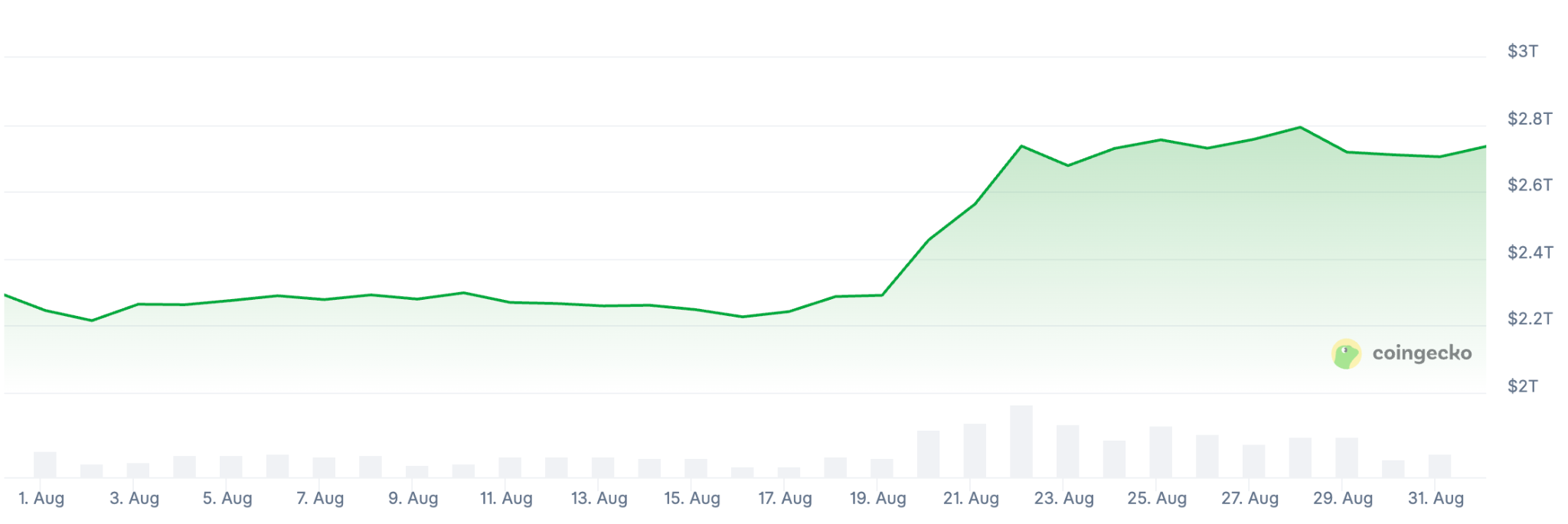
August's total crypto market cap traced a clear two-phase pattern. The first three weeks were characterized by range-bound consolidation between roughly $2.2T and $2.35T, with no meaningful directional conviction. This period coincided with the legislative uncertainty around the CLARITY Act: the Senate confirmed on August 6 that no floor vote would happen before the recess, removing a potential positive catalyst, while the Coinsbuy hack on August 9 added a minor negative.
The picture changed sharply around August 19-21, when the market broke decisively upward. The chart shows the steepest single-leg move of the month, carrying total cap from approximately $2.35T to nearly $2.75T in roughly two days. This acceleration aligned directly with the period when Bitcoin ETF inflows hit their sustained nine-session streak (August 17-27) and the GENIUS Act NPRM was published, signaling regulatory progress on stablecoins. The Zcash surge on August 22 likely added an incremental altcoin bid. The market then plateaued in the $2.7T–$2.85T range from August 22 onward, peaking near $2.85T around August 28–29, leaving the month's close near $2.75T with a gain of roughly 20-25% from the early-August starting point and the strongest monthly performance of 2026.
Bitcoin's Best Month of the Year: From $62,600 to $80,797
Bitcoin entered August near $62,600, carrying the late-July selling pressure caused by token unlocks and thin summer volumes. The recovery that followed was sharp and consistent: the currency gained approximately 25% over the month, its strongest monthly performance since a 37% rally in November 2024 and the best August the asset has had since 2017. Bitcoin reached its monthly high of $80,797 on August 25, touching $81,000 during Asian hours the following day before a pullback set in.
The primary driver of the move was institutional demand through ETF channels. US spot Bitcoin ETFs recorded $3.52 billion in net inflows for August, their best monthly total of 2026 and a sharp recovery from just $172 million in July. The funds saw net inflows on 16 of 21 trading days, including a nine-session consecutive streak from August 17 through August 27. Total ETF net assets rose 31% over the month, from $76.29 billion to $99.61 billion, while monthly trading volume climbed 49% to $58.63 billion. Year-to-date net outflows were cut by roughly two-thirds, from $5.29 billion to $1.77 billion. Ether ETFs also turned positive for 2026, ending August with $732 million in year-to-date net inflows after they had been more than $1 billion in the red at the end of July. XRP ETFs reached $502 million in year-to-date net inflows.
The rally peaked in the final days of the month and then encountered its first serious headwind. The Federal Reserve's annual Jackson Hole symposium ran August 27–29 under the theme "Financial Innovation: Implications for Payments and Policy", a framing that attracted unusual attention from the crypto market given its direct relevance to digital asset infrastructure. New Fed Chair Kevin Warsh delivered his first keynote address on August 28, and while he addressed digital payments, his broader messaging struck a hawkish tone that dented market sentiment. Bitcoin pulled back from its highs and entered September below $80,000, with ETF flows briefly turning negative on the first trading day of the new month.
The August recovery extended well beyond Bitcoin. Zcash (ZEC) surged more than 30% in the week ending August 22, briefly reaching an eight-year high of $855 — its strongest level since 2018 and a recovery of more than three times its June low near $250. The immediate catalyst was Grayscale filing its fifth amended registration statement with the SEC to convert the existing Grayscale Zcash Trust into a US exchange-traded fund, to be listed on NYSE Arca under the ticker ZCSH with a proposed annual fee of 2.5%. A subsidiary of Grayscale parent Digital Currency Group is also in nonbinding discussions to contribute approximately 200,000 ZEC to the trust. The episode illustrated that the altcoin ETF pipeline now extending well beyond Bitcoin and Ether has become a live and independent market catalyst.
US Legislation: CLARITY Act Survives on Procedure, GENIUS Act Rules Move Forward
The CLARITY Act entered August with its 2026 passage prospects already in doubt after failing to secure a floor vote before the recess. On August 6, Senate Majority Leader Thune publicly confirmed there would be no vote before the break, citing unresolved disputes between Democratic and Republican negotiators over three main issues: the scope of the bill's ethics provisions targeting senior government officials' involvement in crypto projects, the treatment of stablecoin yield and rewards products, and the strength of illicit-finance safeguards.
Despite missing the recess window, the bill did not die. After a marathon overnight Senate session on August 7–8, Thune filed a motion to proceed on the Digital Asset Market Clarity Act on the morning of August 8, initiating the formal cloture process that governs Senate consideration of contested legislation. The move was the farthest the bill had progressed in the formal legislative process, and it positioned the Senate to hold its first procedural cloture vote almost immediately after returning in September, potentially as early as September 15. Industry observers interpreted the filing as a signal of genuine intent from leadership rather than a procedural formality, though the bill's fate in September remains genuinely uncertain.
The GENIUS Act followed a more orderly path. On August 17, the US Treasury Department published a formal Notice of Proposed Rulemaking implementing section 3 of the GENIUS Act, opening a 60-day public comment window running to October 19. The OCC, which has jurisdiction over nationally chartered bank and trust operations, is targeting November for final regulations, with the goal of being able to process permit applications for permitted payment stablecoin issuers before the close of the year. The Blockchain Association formally backed the Treasury's proposed framework on August 25. The GENIUS Act's statutory effective date of January 18, 2027 remains in place. After that date, issuing a payment stablecoin in the United States without an appropriate federal or state license becomes unlawful.
Tokenized Equities Break Records: The RWA Market Matures
The tokenized real-world asset market posted its most significant growth metrics on record during August. Monthly transfer volume for tokenized equities surged 415% over the 30 days ending August 29, reaching $29.5 billion, while monthly active addresses jumped 209% to approximately 1.3 million and total holder addresses rose 167% to 2.36 million. Total on-chain RWA value across public blockchains reached approximately $38 billion by late August, up from $33.5 billion in early July, with tokenized stocks now accounting for over 15% of the total RWA market capitalization.
Ethereum retained the largest absolute share of the RWA market, holding approximately $17.2 billion in tokenized assets, and continuing to serve as the primary settlement layer for institutional products. BlackRock's BUIDL fund passed $2.8 billion in total asset value, deployed across Ethereum, Solana, Polygon, Avalanche, Arbitrum, and several other networks, reinforcing its role as the primary tokenized money market instrument used as collateral across DeFi lending and derivatives protocols. Solana, however, led in new flow velocity, attracting $348 million in net RWA inflows over the 30-day period and serving as one of the primary networks for tokenized equity trading alongside Robinhood Chain and BNB Chain.
The August volume figures represent a structural shift rather than a speculative spike. The user base growth, holder addresses up 167% and active addresses more than doubling, suggests that the expansion of tokenized equities in August was driven by genuine product adoption, including through Robinhood's stock token offering launched in July, rather than by a small number of large transactions inflating headline numbers. The DTCC's tokenization pilot with over 50 firms continues to target an October 2026 commercial rollout, and if that proceeds on schedule it would be expected to drive another step-change in institutional RWA volume in Q4.
Infrastructure in Testing
August marked a critical month for two of the crypto ecosystem's most consequential pending protocol upgrades. Solana's Alpenglow consensus overhaul, targeting a reduction in transaction finality from approximately 12.8 seconds to 100–150 milliseconds. The Agave v4.2 client release went out on August 17, testnet feature activation was completed on August 19, and the network moved into extended validator coordination ahead of a planned mainnet activation targeting late September or October 2026. The upgrade's significance extends beyond raw performance: Alpenglow's finality speed brings Solana into a regime where real-time settlement of complex financial transactions becomes technically viable in a way that prior consensus designs did not support.
Ethereum's Glamsterdam upgrade, which targets parallel transaction execution and a substantial reduction in gas fees, hit a significant setback and a milestone in the same month. The upgrade's mainnet target was pushed back from the first half of 2026 to Q4 2026 as developer teams identified additional testing requirements. Simultaneously, the Platåberget public testnet for Glamsterdam went live on August 17, a dedicated early-stage testing environment that will run for several months before the upgrade moves to the Sepolia and Hoodi public testnets. The delay is not unusual for Ethereum's upgrade cadence, but it means that the gas fee improvements the upgrade delivers will not reach mainnet until Q4 at the earliest, a delay of approximately six months from the original schedule.
A different kind of infrastructure signal came from outside the blockchain ecosystem itself. On August 4, Cloudflare announced Cloudflare Wallets - programmable crypto wallets designed for AI agents rather than human users. Built around the x402 payment protocol, the product enables AI agents to autonomously purchase API access, digital content, and compute resources on the web within operator-defined safety guardrails, while providing verifiable on-chain identity for each agent. The announcement is significant as a signal of where the broader internet infrastructure industry sees crypto payment rails fitting into the next phase of the web: not primarily as a retail investment vehicle, but as the native settlement layer for machine-to-machine transactions in an economy increasingly driven by AI agents acting autonomously on behalf of users.
Group Update
On 27th August 2026, Advanced Blockchain held its Annual General Meeting (AGM). All agenda items passed, most with well over 99% shareholder support. Resolutions included individual discharge of the Management Board and Supervisory Board for the 2025 financial year, election of the auditor for 2026, confirmation of Mathias Roch's prior Supervisory Board appointment, and the election of Andreas Appelhagen to the Supervisory Board. Shareholders also approved new authorized and conditional capital, convertible bond issuance authorization, several Articles of Association amendments, and Supervisory Board remuneration. Full voting results are available here.
The management board presentation reflected on many key activities that took place during the year 2025 as well as in 2026, laying out the company's path toward long-term growth and sustainable value creation. Central to this is the ABAG 2.0 strategy, which centers on rebuilding credibility across operations, governance, legal, and finance, alongside the build-out of ABX Analytics as a recurring-revenue pillar. On the audit front, Incredulous Labs' opinion moved from a disclaimer in 2023-2024 to a qualified opinion in 2025 on a substantially cleaned-up basis, positioning 2026 as a fresh chapter built on a clear foundation.
The presentation also covered 2025 financial results for both Advanced Blockchain AG and Incredulous Labs, which were weighed down by non-cash fair value losses and impairments concentrated in a limited number of legacy positions, alongside elevated legal and advisory costs tied to historical clean-up. Management outlined a roadmap to address refinancing risk ahead of the 2027 convertible bond, as well as the active pursuit of legal claims and recoveries.
On the growth side, the AGM saw the announcement of Project Nutrivo, a new scan-to-earn mobile app incubated within the ABAG 2.0 innovation pillar, currently in MVP development with a prototype expected by year-end. The session closed with a peer comparison and an overview of portfolio company key advancements, demonstrating continued momentum across the ecosystem.
Following the AGM, on 2nd September 2026 the Supervisory Board elected Mathias Roch as its new Chairman, succeeding Rüdiger Andreas Günther, who had held the role since August 2023 and remains a Supervisory Board member. Andreas Appelhagen, newly elected to the Supervisory Board at the AGM, was appointed Deputy Chairman.
Portfolio Update

Silencio - The Silencio team signed the largest contract till date. A frontier AI lab is buying African voice data at scale. Weekly USDC payouts are now live for high-quality recordings in Swahili, Amharic, Hausa, Wolof, and Yoruba. Paid transcription tasks for these languages have also started. The deal brings the project close to crossing $1M in 2026 revenue, which would trigger buybacks.
Silencio is now heading to Interspeech 2026 in Sydney and will sponsor Indigenous Voices Day.

peaq - Korea's public data is now available to robots and machines running peaqOS. Any machine on peaq can directly query Korea's official open data portal. Charger availability, precise weather conditions, air quality and much, much more in 11,867 open government APIs behind one portal now.
The peaqOS Unitree App was also launched, letting Unitree robots gain identity, report health, and do business onchain. World ID integration went live on peaqOS, allowing robots to verify real humans without learning their identity.
This month Peaq expanded what robots and machines can do on peaqOS with stronger identity, verification, and real-world data access.
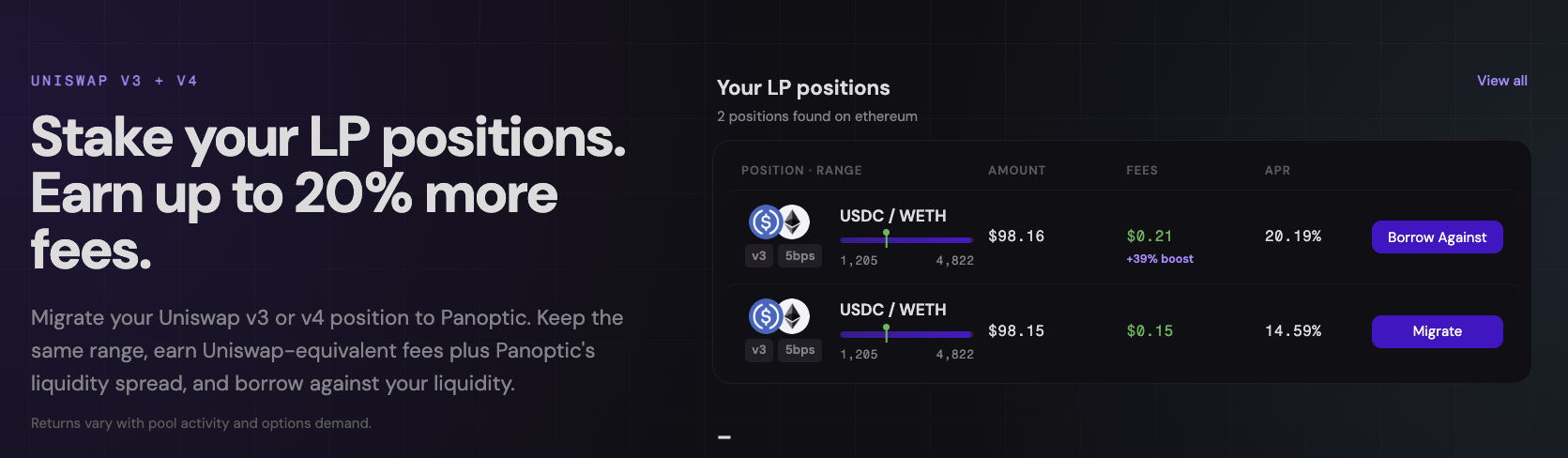
Panoptic - Panoptic users can now stake Uniswap LP positions (such as ETH/USDC) through Panoptic. They keep earning swap fees while collecting up to 20% more through options premiums. Same pool, same range, higher returns.
Pips Season 2 wrapped up with 25M Pips allocated. Season 3 is now live in the WETH/USDC pool. The team also shared detailed posts on how Panoptic connects carry trades and convexity, helping Uniswap LPs get better compensation for the risk they take.
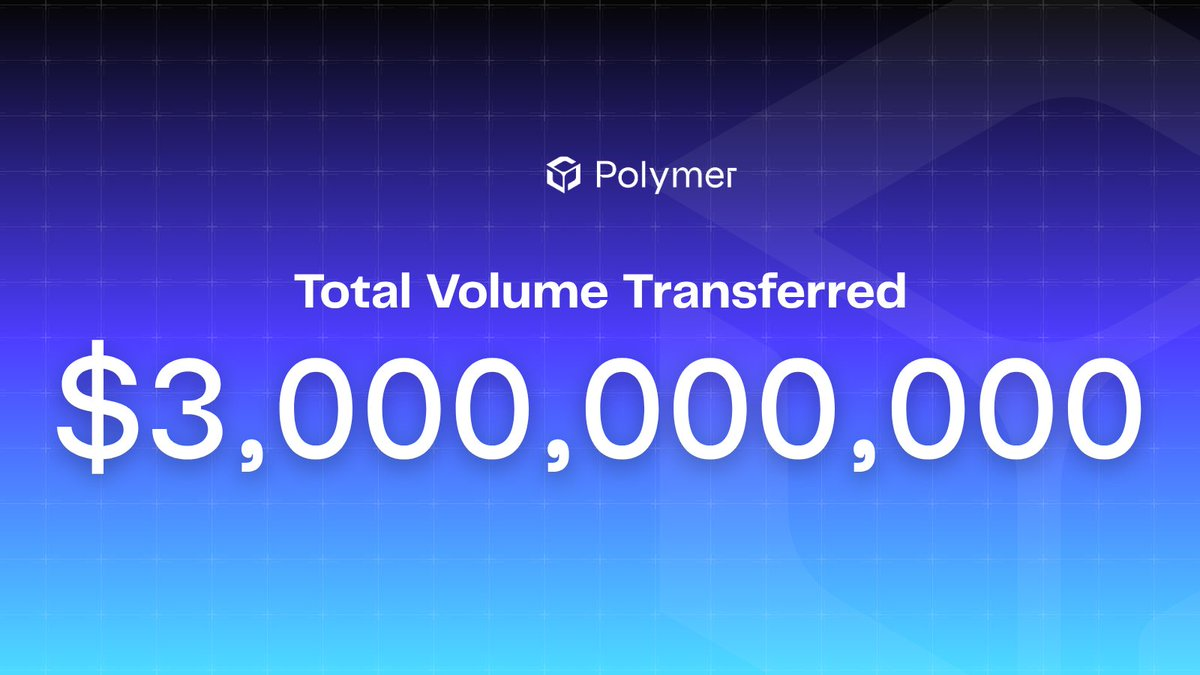
Polymer - The protocol crossed $3B in total value transferred. This came just three months after hitting $2B. Large transfers continued with zero slippage, including multiple seven- and eight-figure moves settled one-to-one.
Polymer’s Prove API usage hit a record last month, with over ~74,000 proofs generated in the month. Polymer handled a high share of USDC cross-chain volume while expanding reliable rails across dozens of chains.
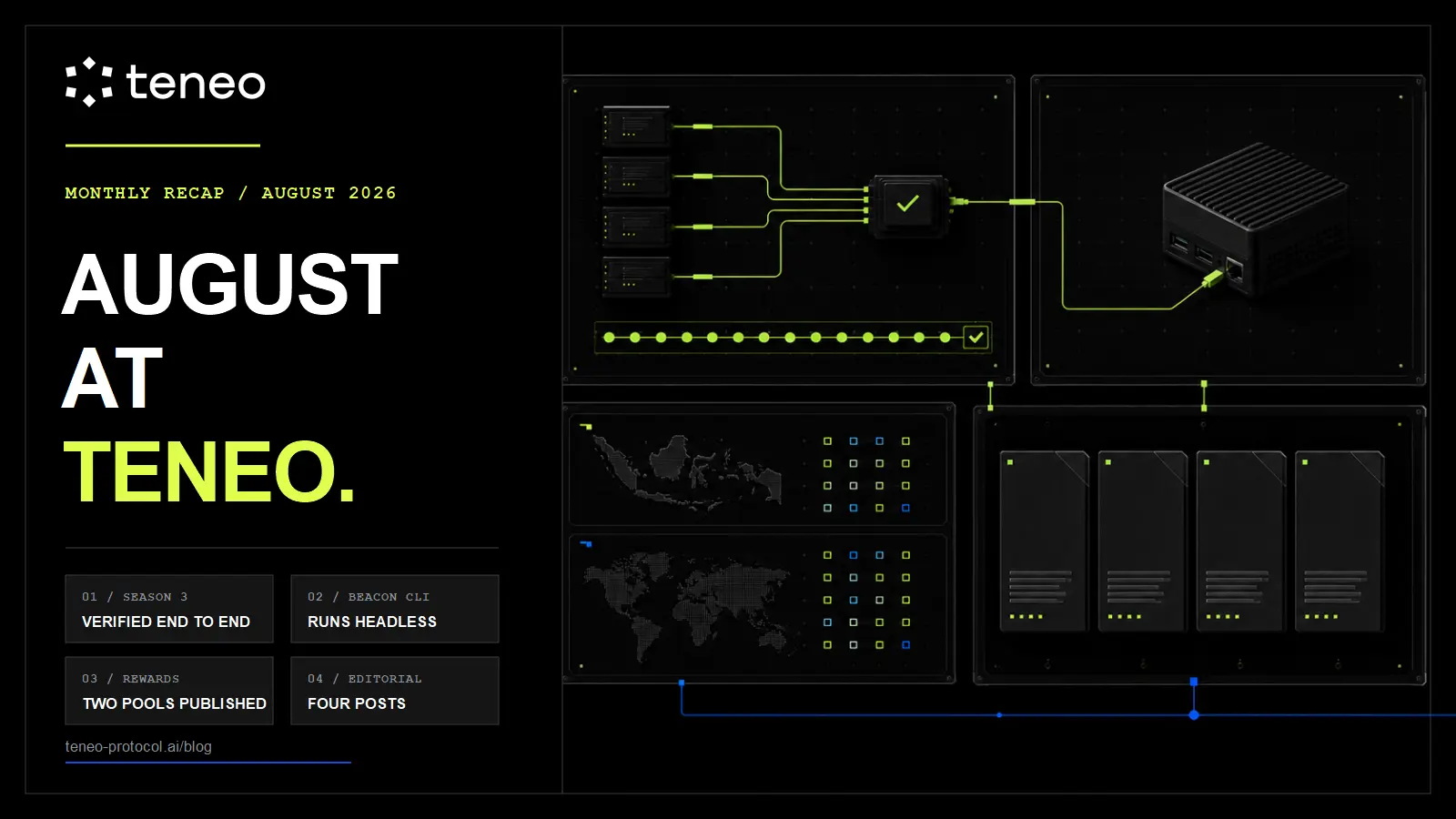
Teneo - Teneo season 3 closed as the first fully verified season. The Beacon now runs headless through a CLI, so it can stay online on a Raspberry Pi, old laptop, or home server without needing a screen.Reward pools for Season 3 were published, including a regional Indonesia pool.
The team also released several research posts on the agent economy, DePIN, and the shift from cheap inference to the need for real-time data.
Closing Remarks
August was the strongest month of 2026 for crypto markets, with total market capitalization climbing roughly 20-25% and Bitcoin posting its best monthly performance since 2017 on the back of sustained ETF inflows. The GENIUS Act's implementing rules advanced on schedule, the CLARITY Act survived a difficult stretch to reach the Senate's formal cloture process, and the tokenized RWA market posted record growth, all pointing to an industry whose regulatory and institutional foundations continue to strengthen even as legislative timelines remain uncertain.
For Advanced Blockchain, this was a pivotal month in the group's own turnaround. The AGM on 27th August saw shareholders approve every agenda item by a clear majority, giving the Company the capital flexibility and governance structure to support its ABAG 2.0 strategy going forward. The Management Board's presentation set out a clear path toward rebuilding credibility and long-term value creation, and the subsequent election of Mathias Roch as Chairman of the Supervisory Board reflects the continued strengthening of ABAG's leadership as it enters this next chapter.
Across our portfolio, momentum carried through the month: Silencio's landmark African voice data deal, Polymer crossing $3 billion in total value transferred, Panoptic's expanded LP staking capabilities, and Teneo's fully verified third season all point to projects building real usage and revenue through the cycle. We look forward to sharing further progress as ABAG's restructuring work translates into renewed growth.
Best regards,
Your Advanced Blockchain Team
.svg)

.svg)

