Ecosystem Update September 2026
We are pleased to share the September 2026 Ecosystem Update, highlighting developments in the macro environment, market performance, the broader industry landscape, and Advanced Blockchain’s ecosystem.
Macro Overview
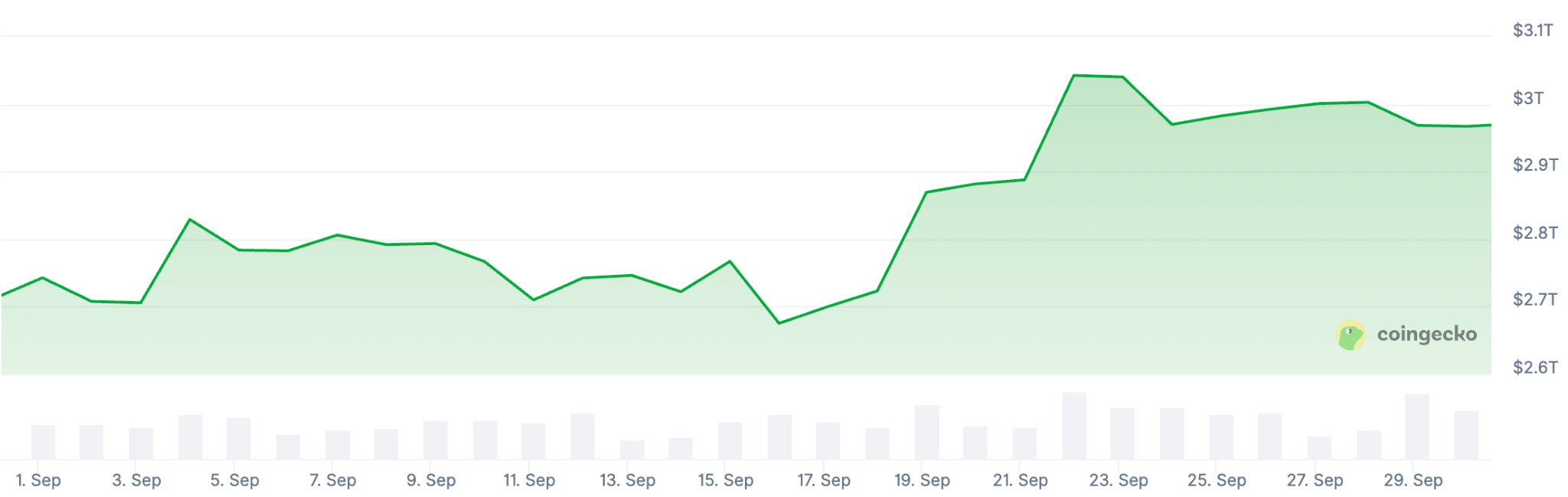
Source: Coingecko
September's total crypto market cap traced a clear two-act structure that maps almost precisely onto the month's two defining macro shocks and their resolution. The market opened near $2.7 trillion and surged to an early peak around September 4-5. From that early peak, the chart shows a slow, grinding consolidation through the first half of the month as the market marked time ahead of the CLARITY Act cloture vote. The sharp trough visible around September 16 is the fingerprint of both shocks landing within 24 hours: the 49–50 Senate cloture failure on the 15th followed immediately by the Federal Reserve's 25-basis-point rate hike on the 16th, which together pushed total market cap to its monthly low near $2.68-2.70 trillion. The recovery that follows is striking in both its speed and its magnitude: starting from the September 17 floor, total market cap rallied roughly 12-13% in under a week, crossing $3 trillion around September 22-23 for the first time since late 2025, a move amplified by Bitcoin's September 21 monthly high of $87,397, record single-day ETF inflows of approximately $999 million. The market settled and consolidated in the $2.95-3.05 trillion range through month-end.
US Regulation in a Post-CLARITY Act World: the SEC and CFTC Act Independently
The Digital Asset Market Clarity Act reached its decisive moment on September 15. The Senate's cloture motion failed 49–50, 11 votes short of the 60 required to advance legislation over a filibuster. All 49 supporting votes came from Republicans; not a single Democrat crossed the aisle. The bill's immediate cause of death was not its market-structure provisions but ethics language: specifically, provisions that would have constrained senior government officials from holding or benefiting from crypto assets, language whose scope directly implicated President Trump's family crypto business interests and which the White House had declined to explicitly accept.
The SEC did not wait for Congress to act. Within 48 hours of the cloture failure, SEC Chair Paul Atkins announced the Innovation Exemption on September 17, a five-year conditional exemptive order covering two categories of market participant: Tokenized Securities Venues, which receive relief from the statutory definition of a securities "exchange", and certain liquidity providers, which receive relief from the "dealer" definition. Platforms wishing to operate under the exemption need only provide notice to the agency rather than file for full registration, subject to caps on the number of securities symbols and trading volume limits. Publicly listed companies retain a 30-day window to object to third-party tokenization of their shares. The order runs from September 17, 2026 through September 17, 2031, and the SEC has simultaneously opened a comment period on all aspects of the relief, signalling that a more formal notice-and-comment rulemaking may follow.
The CFTC moved on the same day. Chairman Mike Selig submitted a formal crypto rulemaking proposal to the White House on September 17, the contents of which had not been made public at month-end but which multiple sources described as covering crypto asset classification and trading market structure. The CFTC also broadened its existing no-action relief to cover all qualifying passive software providers operating on crypto networks. On the stablecoin front, the OCC accelerated its timeline, with the Comptroller publicly stating in mid-October that final rules were expected by October 31, ahead of the January 18, 2027 statutory effective date. The collective actions of the three regulators in the week following the CLARITY Act's collapse amounted to the most significant unilateral regulatory shift in US crypto policy since the first wave of SEC enforcement actions in 2023.
The SEC's Innovation Exemption was not issued in a vacuum: it landed into a tokenized securities market that had already spent several months building infrastructure in anticipation of exactly this kind of regulatory clarification. Total on-chain real-world asset value reached approximately $38.8 billion by mid-September and crossed approximately $39 billion by month-end. US Treasuries remained the dominant asset class at approximately $15.7 billion, roughly 40% of total distributed RWA value. Private credit followed at approximately $8 billion, or around 21%. Ethereum retained its position as the primary settlement chain with approximately $17.3 billion in tokenized RWA on-chain, reflecting deep institutional trust in its smart contract ecosystem for high-value settlement.
The RWA Market Crosses $39 Billion as the SEC Clears the Path for Tokenized Stocks
The Innovation Exemption's significance for the RWA market is both immediate and structural. In the immediate term, it removes the regulatory uncertainty that had prevented most major US-licensed venues from offering tokenized stock trading: under the order, a platform qualifying as a Tokenized Securities Venue may begin operations upon notice, without waiting for either Congress or a formal SEC rulemaking. In structural terms, the five-year relief window creates a defined period during which the SEC has signalled it will observe how tokenized stock markets develop before drafting permanent rules — a model it has used in adjacent markets, such as alternative trading systems and certain FinTech products, to allow market structure to develop before being codified. Law firms advising tokenized equity platforms described the notice requirement as the most accessible entry pathway the SEC has ever created for a new class of securities market participant.
The European RWA market continues to develop under MiCA's more prescriptive framework. The CASP authorization count on the ESMA register grew from 321 in the July 31 post-deadline update to approximately 343–367 by late September, reflecting continued momentum in applications despite the licensing process's cost and complexity. The Robinhood Chain-based tokenized equity ecosystem launched in July has become one of the primary venues.
Three separate regulatory developments in September, each from a different jurisdiction and a different market segment, converged on the same conclusion: non-US financial institutions have moved from observing the US regulatory environment to committing to it. The earliest and broadest was Revolut's conditional approval from the US Office of the Comptroller of the Currency to form a national bank, making the UK-based fintech, which serves more than 80 million customers globally, one of the first non-US consumer financial technology companies to clear the first regulatory gate toward a US chartered bank. If completed, the charter would allow Revolut to offer loans, FDIC-insured deposits, credit cards, stablecoins, and crypto to US customers under a single federal licence. Revolut also obtained bank licences in France, the UK, and Australia within 2026, making its US charter application part of a broader pattern of escalating regulatory ambitions across major markets simultaneously.
Non-US Institutions Push Into the US Market
A week later came a more targeted but equally significant move in derivatives markets. On September 10, the Singapore Exchange obtained CFTC Regulation 48.10 authorisation to offer its Bitcoin and Ether perpetual futures to US institutional investors directly. Under CFTC Regulation 48.10, a recognised Foreign Board of Trade may grant US institutional participants direct access to its markets without registering as a full US exchange — a framework designed specifically for established foreign venues with robust domestic oversight. SGX's products have accumulated $5.8 billion in cumulative volume since their November 2025 launch and are structured using traditional margin calls and collateral top-up mechanics rather than the auto-liquidation model common in crypto-native perpetuals, a design choice that aligns more closely with how US institutional risk managers operate. Products are benchmarked to CoinDesk Indices under the EU Benchmark Regulation, providing a level of index governance that US institutional compliance teams can evaluate using familiar frameworks. SGX has also indicated plans for dated futures and options products on Bitcoin and Ether. The development bridges major US institutional liquidity pools with Asia-based trading infrastructure in a way that had not been formally available before the CFTC authorisation.
The third development arrived on September 17 when Crypto.com's US subsidiary Nadex had its SEC registration for single-stock security futures take effect, with the SEC acknowledging the registration on September 16. Crypto.com CEO Kris Marszalek also publicly stated the company is working with both the SEC and the CFTC to obtain the regulatory approvals required to offer single-stock perpetual futures to US retail and institutional customers, a product category that does not yet exist in the US market. Crypto.com's Hong Kong and Singapore-headquartered structure means that its US push comes through subsidiary and regulatory registration rather than a corporate relocation, a model different from the exchanges that originally built their businesses in the US.
Taken together, these three developments in a single month: a banking charter conditional approval, a derivatives market cross-border authorisation, and a derivatives registration, signal that the gradual opening of the post-CLARITY Act US regulatory environment has moved from hypothesis to active institutional planning outside the US.
Group Update
On 30 September 2026, Advanced Blockchain AG published its 2026 Half-Year Report. The first half of the year was a strategic and organisational reset. With the key reporting, audit and governance processes now complete, the focus has moved to delivering the ABAG 2.0 strategy: securing additional financing, monetising selected portfolio holdings and building new operating businesses, in particular ABX Analytics. Revenue was below the prior-year period because no strategic holdings were divested. The half-year result was EUR -703.5 thousand, compared with EUR -586 thousand a year earlier, and was mainly driven by legal and advisory costs for asset protection and by bringing previously external activities in-house, which should reduce costs going forward. The full report can be accessed here.
GBC AG is preparing a new research report on Advanced Blockchain AG, which will assess the company’s progress under the ABAG 2.0 strategy. Publication is expected during the course of October 2026.
Work also began on planning the 2026 audit of Incredulous Labs. Last year’s audit moved the opinion from a disclaimer to a qualified opinion. This time the goal is to finish the audit early next year so that ABAG can hold its 2027 AGM earlier, giving shareholders more timely reporting and a predictable corporate calendar.
On the innovation side, Project Nutrivo, the scan-to-earn mobile app announced at the AGM, is moving quickly. Having completed its proof-of-concept phase, the project is now in MVP development and is progressing on schedule against its predefined milestones.
Finally, ABAG submitted its application for the German research allowance (Forschungszulage) for ABX Analytics. The application covers the R&D work behind the platform’s data and analytics capabilities. Initial feedback from the BSFZ (Bescheinigungsstelle Forschungszulage) is expected within 60 to 90 days. A positive decision would provide non-dilutive government funding for the development of ABAG’s recurring-revenue pillar.
Alongside these initiatives, the group continues to evaluate opportunities to divest selected portfolio holdings strategically, acting only where the timing and terms support long-term value creation for shareholders.
Portfolio Update

Silencio - This was a high-visibility month for Silencio. The team attended Interspeech 2026 in Sydney as a Silver Sponsor and Full-Day Sponsor of Indigenous Voices Day. They represented the contributor network at the biggest speech AI conference and highlighted the value of real, consent-based recordings in low-resource and Indigenous languages.
The network continued to grow past 2.5 million contributors across 180+ countries. Educational posts focused on why real voice data still beats synthetic alternatives, the importance of dialects, code-switching, and proper metadata. Weekly payouts from the large African language deal remained active.
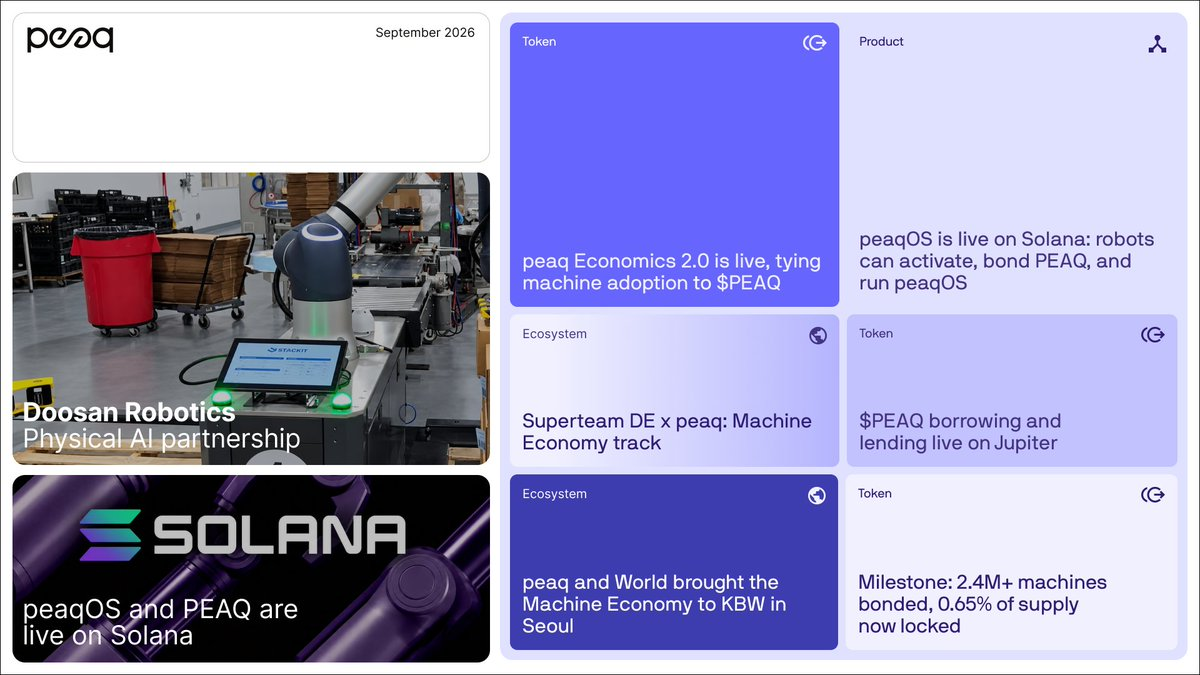
peaq - Peaq Economics 2.0 went fully live this month, tying machine adoption directly to $PEAQ demand through bonding. Over 2.4 million machines bonded $PEAQ, representing about 0.65% of supply.PEAQ and peaqOS expanded to Solana, allowing robots to bond $PEAQ there.
The first $PEAQ borrowing and lending market launched on Solana via Jupiter Offerbook. A Physical AI partnership was announced with Doosan Robotics, one of the top robot makers.
Peaq also co-hosted a Korea Blockchain Week event with World Network in Seoul and ran a Machine Economy hackathon with Superteam Germany.
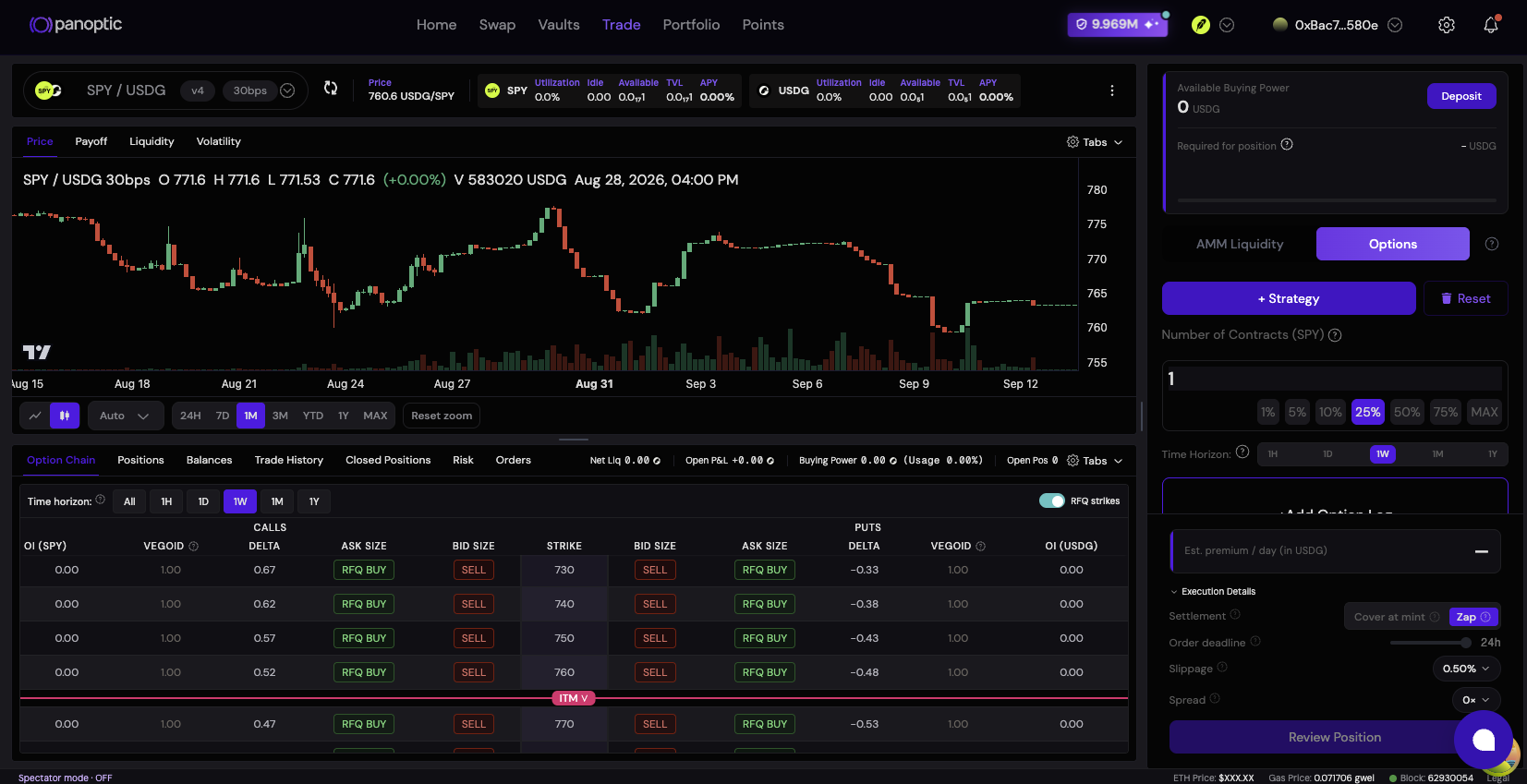
Panoptic - Panoptic protocol was launched on Robinhood Chain, bringing onchain lending, borrowing, perpetual options, and an improved LP experience to the new Layer 2.Season 3 Quests went live, letting users build Pips multipliers through daily streaks, trading, portfolio milestones, and more.
A VIP list of 5,000 Uniswap LPs was announced, with boosted rewards for eligible wallets that move liquidity into Panoptic.
New portfolio tools also helped LPs see the probability of staying in range and expected time in range based on realized volatility.
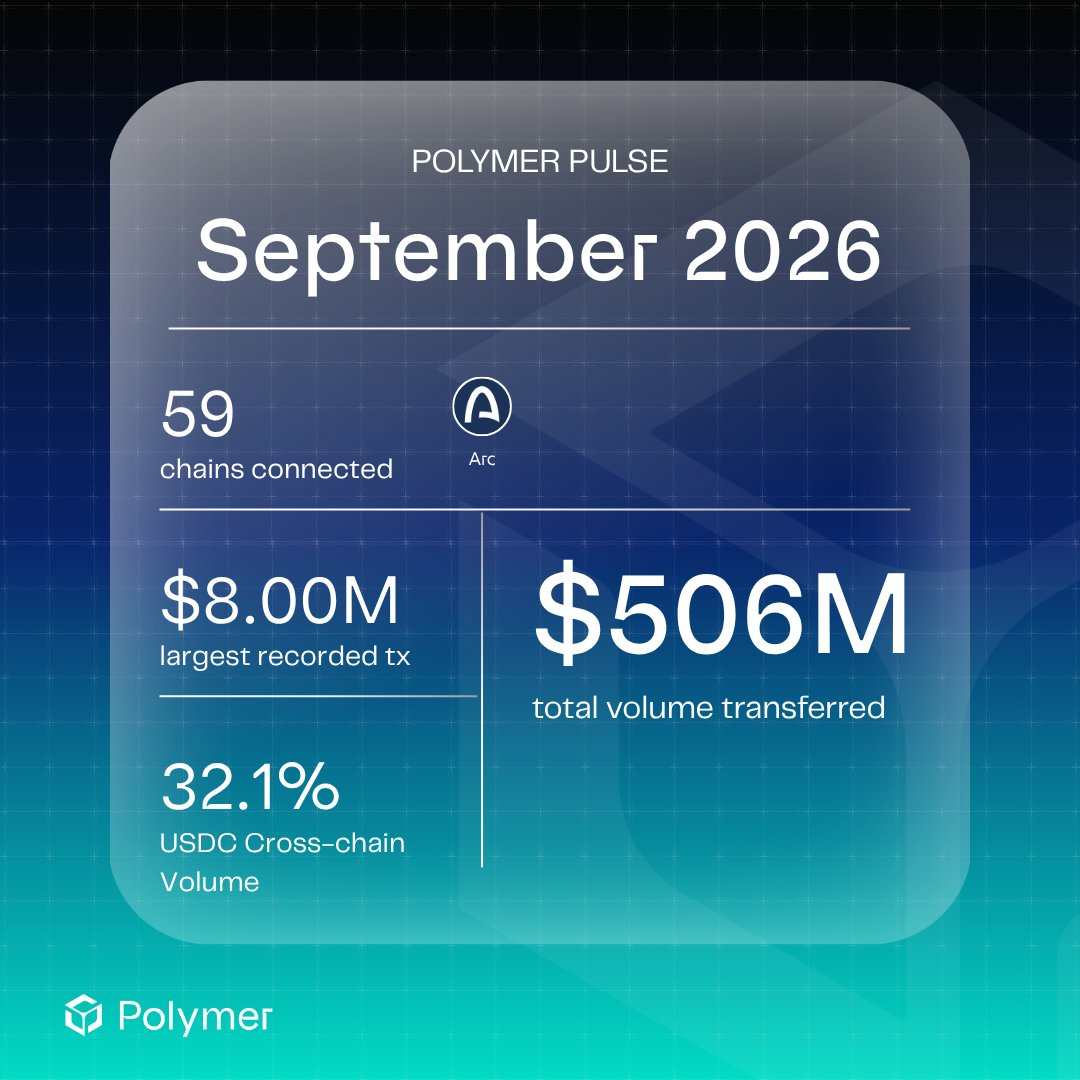
Polymer - This was another record month for Polymer. Monthly volume hit $505.8M, this was a third consecutive all-time high. The protocol cleared about 32% of all USDC cross-chain volume, holding the #1 share for the seventh month in a row.The zero-slippage CCTP bridge crossed $2B in volume.
Large transfers kept moving one-to-one with no slippage. Intent's volume went up a lot, and more people used the bridge.
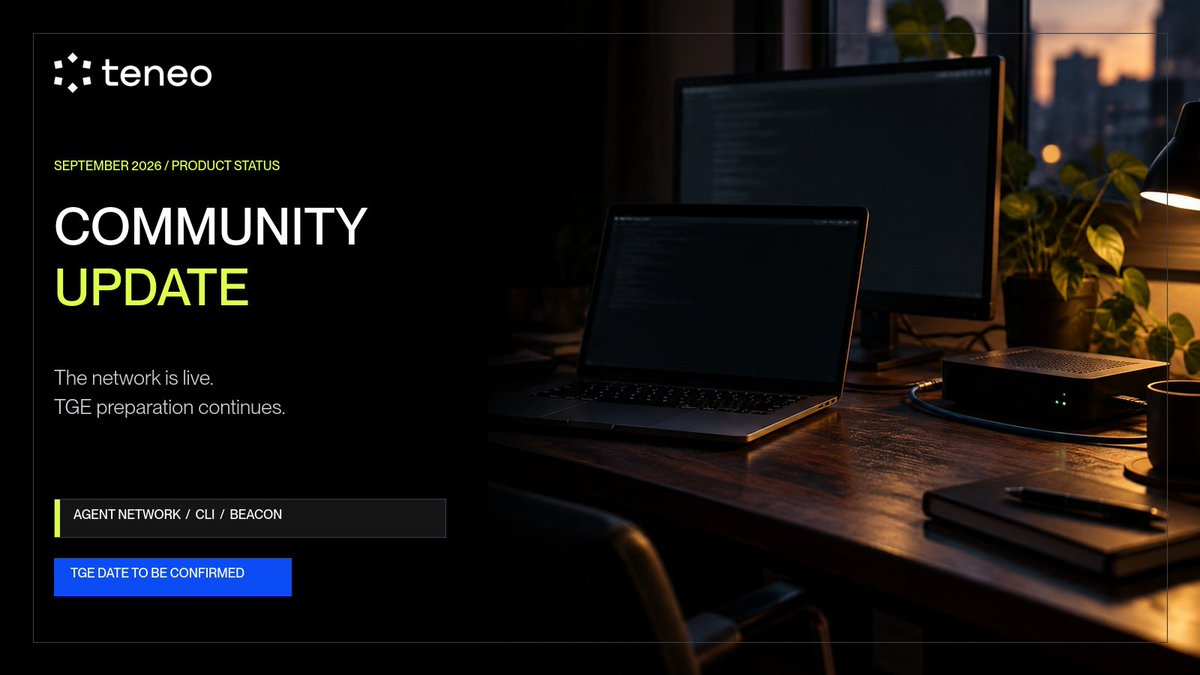
Teneo - The Teneo network is running smoothly while the team prepares for the next stage. The agent network, CLI, and Beacon are live and working. Developers continued building with the SDK and Agent Console.
Most of the team’s time went into preparing for token launch. About $8,000 in rewards had already been paid to Beacon operators. They published a few blogs about how to check what AI agents actually do and why real bandwidth matters.
Closing Remarks
September was a month of sharp contrasts for crypto markets. The failed CLARITY Act cloture vote on September 15 and the Federal Reserve’s 25-basis-point rate hike the following day pushed total market capitalization to its monthly low. The recovery was swift: within a week the market crossed $3 trillion for the first time since late 2025, helped by Bitcoin’s monthly high of $87,397 and record single-day ETF inflows. The more lasting story was regulatory. With Congress stalled, the SEC’s Innovation Exemption, the CFTC’s rulemaking proposal and the OCC’s accelerated stablecoin timeline showed US regulators moving ahead on their own. At the same time, Revolut, SGX and Crypto.com showed that non-US institutions are now actively planning for the US market. The tokenized RWA market, which crossed $39 billion, stands to be one of the clearest beneficiaries of this shift.
For Advanced Blockchain, the focus is now on delivering the ABAG 2.0 strategy and the initiatives within it. Planning for the Incredulous Labs audit has started early, with the aim of holding the 2027 AGM sooner. Nutrivo is progressing through its MVP phase on schedule, and the Forschungszulage application for ABX Analytics has been submitted. We look forward to the publication of GBC AG’s new research report in October.
The portfolio also kept up its momentum. peaq launched Economics 2.0 and announced a partnership with Doosan Robotics. Polymer set a third consecutive monthly volume record and held the top share of USDC cross-chain volume for the seventh month running. Panoptic launched on Robinhood Chain, Silencio took a prominent role at Interspeech 2026, and Teneo is preparing for its token launch. Together, these show projects building real usage through a volatile market. We look forward to sharing further progress in the coming months.
Best regards,
Your Advanced Blockchain Team


